This has little to do with dinner... unless you think about the grocery store scene. Still...

8/28/2007


Holy Basil
 I was saved by basil tonight.
 As I was driving us home from the airport at 6:30 pm, I realized that dinner had to be made as soon as I stepped foot in the house. All of us were starving not only for food but for the delight of sitting around our own table with a real meal made just for us. You see, we had been on vacation for just over two weeks, the last week or so visiting national parks in Wyoming.
We weren't roughing it by any means. We stayed in little cottages and a beautiful inn while traipsing through Yellowstone and the Grand Tetons. No little camp stove dehydrated meals. But we still had to reckon with cafeterias and the potential icky quality of food prepared for masses.
So the stakes were high as I cruised along the Van Wyck Expressway. I didn't want to take the time to stop at the store to buy ingredients, and I certainly did not want to eat out. And then I remembered that little planter box of basil that I planted in May.
The first graders at my school sold their little seedlings for 25 cents a pop, and I planted two of them along with some tarragon and some rosemary just outside my kitchen door. Would the basil still be okay?
Thanks to some incredibly conscientious neighbors the plants had grown about half a foot since we left. They were full of gorgeous dark green leaves just waiting to be picked. I found some pinenuts in the fridge (toasted them), chopped up in the cuisinart the last edible pieces of some parmesan, added the nuts, a bit of salt, a bit of garlic, and about 20 basil leaves. A few whirrs later with some olive oil streamed in and I had some pretty magnificent pesto.
Luckily I had a couple of half boxes of spaghetti that were all about the same size. Voilà! Pasta with Pesto.
Dinner was ready in about 20 minutes. Afterwards we watched a slideshow of our vacation photos from iphoto, and I think we were each a bit ambivilent about having left our hiking adventures behind. The memories of the cafeterias paled with the reminder of Old Faithful, the enormous moose grazing by the side of the road, and the mud pots boiling up from the earth.

Thank you basil, for being the most sublime herb of summer.
And thank you neighbors for tending after our garden while we were gone.
7/21/2007
True Confessions

"Homemaking" was a mandatory course for all girls when I was in high school. The walls came down a few years after my spin with sewing and cooking, and boys started to take a class called "Bachelor Living" and for some girls it was okay to take shop. I missed that wave and found myself in the full estrogen laced arena of Home Ec. I was so happy in the initial class that I went on for part two.
In that class we learned about jello molds, needlepoint, and the teacher introduced us to real cheese. I was enthralled to find that there was more than Cracker Barrell and American Singles. Brie, Camembert, and Port Salut where revelations. I also completely got into nutrition. This was back in the day when Adele Davis would turn up on The Merv Griffin Show, and her Let's Eat Right to Keep Fit found it's place on my shelf. It might have been a good idea for me to study a foriegn language in high school, but learning about all that cheese set me up for real success in French.
It was during this period that the teacher handed out applications for membership to the FHA or Future Homemakers of America. I didn't know much about it, but I signed up for it anyway. I carried my card at first with pride (not realizing the shoe box my thinking could be folding myself into) then with irony, and later I either lost it or it fell apart. Now it all just makes me curious.
The term "homemaking" is out of date now and could easily be confused with architecture. [Martha uses the word "homekeeping," which makes me think of housekeeping and house work] It makes me think about what does it take to "make" a home? What are the things that each of us in a family does to create a haven, a nest, something more than a place for our stuff? I believe that making and serving dinner is part of it, but my local diner does that too.
And here's an update: The FHA is now the much more politically correct and ambiguous FCCLA or The Family Career and Community Leaders of America, Inc. Among their purposes is "#3 to encourage democracy through cooperative action in the home and in the community." I can stand for that. Above that though is "to strengthen the function of family as the basic unit of society," which I can be down with depending on how you define family. Beyond the membership card though, I don't get it.
7/14/2007
The Best Camp in the World
 Last summer my dear little one and I went scouting around Westchester looking for things to do that did not involve netflix or having tea. We fell upon a farm built by the Rockefeller's in 1930. We felt so far away from the noise and hustle of the city (and suburbs) and were transported to a bucolic wonderland of flowers, bunnies, trees, chickens, sheep, and a gorgeous barn complex made of stone. We could pretend that we were in another time, hiking in the shady hills, checking on the lambs, trying to name the flowers. "I want to go to camp here," my girl announced.
 And so it is that we have been traveling to Stone Barns every day the past week. The girl is addicted to weaving lanyards, but she has also learned to make hummus, zucchini sticks, and artichoke/spinach dip! How cool is that? The campers feed pigs, collect eggs, dig for potatoes, play games, and (of course) make lanyards. I get to buy farm fresh eggs and vegetables when I go to pick her up—and have an iced coffee. Everybody's happy.
The camp is run by the Stone Barns Center for Food and Agriculture, and they hold workshops, have family work days (harvesting and braiding garlic!), cooking classes, and tours to promote their mission (raising public awareness about farm and food issues). They also have a highly rated restaurant (Blue Hill), which is supposed to be so popular that it's difficult to make a reservation. I haven't tried and have been happy with the iced coffee and egg salad at the cafe.
4/05/2007
Who is This Man and Why Will I Read Anything He Writes?
 Adam Gopnik has a piece in this week’s New Yorker about cooking in literature and comes up with four ways that writers use food in their novels.
 First, he says, there is the “food that is served by an author to characters who are not expected to taste it.” He says that this kind of food is a step out of the action, a little down time in the busy character’s life. What’s key, he says is that there isn’t any appraisal of the food (i.e., was it good, surprising, satisfying, disappointing). I have definitely had meals like that where the point is just to have a break. It doesn’t matter what or where it is, it is so forgettable; I just need to sit down. Gopnik writes that the food, in these instances, is “interchangeable,” and I couldn’t agree more.
The next kind of food in literature is food that the author conjures up and is “served by an author to characters in order to show who they are.” This is my dinner parry food, or why else would I have ever made (or made great effort to learn to pronounce) gougère (cheese puffs), wassail, and so on. Scrooge has his bowl of gruel before the fire, Salinger’s Esmé drinks tea, and once I served up Francis Moore Lappé’s Peanut Butter Balls at an A’s game.
Gopnik goes on to say that an author “cooks for characters in order to eat with them.” That sounds so hospitable to me. These writers are à table. We get to do everything but taste it. I feel like this when I wander through Whole Foods and they have all of those prepared meals on display. I never buy the Nut-Crusted Trout, the Roast Beef with Grilled Red Onions and Bleu Cheese or the Chili Lime Basil Tofu Salad, but it’s entertaining to glide past the perfect-looking dishes with their rosemary spear garnishes.
Last is the author that cooks something up and “actually serves the reader.” These writers, according to Gopnik, invite us into the kitchen and make us feel as if we’re with the characters in real time. Think of Ma Ingalls cooking with her spider on the prairie. My mind goes to film with Stanley Tucci whipping up some eggs in Big Night. Gopnik looks at Ian McEwan’s Saturday, where the protagonist cooks up a Bouillabaisse. That’s a memorable scene for me because I love to sit around in a kitchen and watch people cook. More than that, I love to actually cook with other people. Even though I write about my attempts at getting the dinner on the table, my joy in cooking comes from the joint effort. I like chopping while my father-in-law sautés. I like to grill while someone else makes the salad. I love being in the kitchen with The Husband as we pull a meal together. And one of my biggest thrills is cooking with The Girl, who cannot only crack an egg, but knows how to measure and sift.
3/16/2007
I "heart" gingerbread
 In all modesty there are a couple things I'm good at: 1) I make The Girl call me Mrs. Parker when we're out in the car because I am so darn good at finding great parking spots. Even in Manhattan. I don't have to worry about alternate side of the street parking, but I know where the goods spaces are and when they're likely to be available. 2) I know how to use the web generally (and Google, specifically)really well. I do all kinds of crazy searches to satisfy my quest for mostly useless information.
 It's the latter skill that has failed me today.
Once I had little heart-shaped baking dish: glazed inside, unglazed outside. It was just the right size for MFK Fisher's wonderful gingerbread recipe in How to Cook a Wolf. My memory is that it was made by a Marin County company called Amnion Ware, but when I google that I get all kinds of hits about amniotic fluid or pet medication.
I've looked at all kinds of heart-shaped baking dishes and none are the right size (about 6 inches tall and 2 1/2 inches deep). I'm beginning to think I made the whole thing up.
Still, it's a snow day, and what would be better after dinner than some spicy gingerbread?
Here's the recipe:
Edith's Gingerbread
1/4 C shortening
1/4 C sugar
1/2 C molasses
1/2 tsp. baking soda
1 tsp. cinnamon
1 tsp. ginger
1 tsp. cloves
1 tsp. salt
3/4 C boiling water
1/4 tsp. baking soda
1 1/4 C flour
1 tsp. baking powder
1 beaten egg
Cream shortening and sugar. Sift in the spices and flour and baking powder together. Beat the 1/2 tsp. soda into the molasses until it is light and fluffy, and add to the shortening and sugar.
Add the 1/4 tsp soda to the boiling water, and then add it alternately with the sifted dry ingredients. Fold in the beaten egg when all is mixed well, pour into a greased and floured pan [preferably a heart-shaped pan bought in Berkeley over 20 years ago], and bake about 20 minutes at 325F. This mixture will seem much to thin to make a cake [she's absolutely right!], but do not increase the quantity of flour, as many doubting cooks have tried to do [Not I Mary Frances. I always take you at your word!]
3/03/2007
Confessions of a Luddite
 Our neighbor’s son tells me a joke: What kind of wave does Plankton surf on?
 I get the necessary background info. Plankton is a character on Sponge Bob, a teeny guy who owns a bad fast-food restaurant called The Chum Bucket. I confess my ignorance, “I don’t know. What kind of wave does Plankton surf on?”
“A Micro Wave!” Laughter ensues. Except with me. I don’t get it.
“What’s a Micro Wave?”
My neighbors try to save me from my ignorance. “A microwave. You know, you cook food in it.”
Ahh, yes. The appliance I don’t have and the one that SF Mom keeps prodding me about. “Why don’t you have a microwave, Deb?" I have put her off, knowing that it would probably take even more years of therapy to figure it out, but not getting the joke jars me. It’s time to give this some thought.
1. It’s not that I’m against appliances.
I do rely upon some electrical gadgets. As noted, I recently invested in a crock-pot. I also have a blender that we bought during a cold snap in 1987 so we could make margaritas, play salsa, eat homemade tortilla chips, and pretend that we weren’t living in New York in the winter. I have a hand-held electric mixer that dates back to the ‘70’s and was bought for $10.00 at Gemco. I have a Cuisinart that is even older than that. The shredding disk broke a decade or so ago. The rest of it still works, and I use it for mixing doughs, puréeing, and chopping. We have an electric waffle iron, but I think of that as Evan's since he uses it the most.
I guess I’m not real big on appliances though since I lack not only a microwave but also some other things that people rely upon and possibly couldn’t imagine being without (a toaster, a toaster oven, a sandwich press, a coffee maker, a juicer, and so on.) There is one appliance that I do use every day: my Russell Hobbs electric tea kettle. I could do a commercial for that one.
2. I’ve been unduly influenced by the French
That is, I’ve been unduly influenced by what I perceive to be French, which means it probably came from Jacques Pepin or someone else who writes in English about French cooking. I did have the great fortune of taking cooking lessons in a French woman’s French kitchen about 20 years ago, and that experience conjured up all kinds of fantasies of what it means to cook and serve meals. Fresh ingredients, wrapped in paper not plastic; the necessity of a big table in the kitchen to cook and serve on [I don’t have one]; and that all you need is a good, sharp knife and you’re all set. Madame Jacqueline did not have a microwave. She did, however, have a cute string bag that she took to market to carry home her provisions.
I’m not sure if my French friend, C., has a microwave or not. I know that she is a more imaginative and confident cook than I am. It wouldn’t be a matter of principal with her, probably more an issue of counter space. Which leads me to…
3. Counter Space
I like to have clear counter space. You may not believe that if you walked into my kitchen, but it's true. It’s a fairly constant crusade to keep space clear in my kitchen. There is always a stack of paper, recycling containers, a storage jar that has become empty or that thing for which you just can’t find a place hanging out and hogging my precious counter.
The teakettle has a prominent spot, but I have to figure out a convenient and out of the way place for the bulky crock-pot.
4. A sign of weakness
The microwave, in my sick mind, is interpreted as a sign of my weakness, a signal that I’m not really cooking. I’m heating up. I know, I know. I can hear you saying what’s the difference of a conventional oven and a microwave? Spend an hour waiting for the squash to cook in the oven or a fraction of that time with it in the microwave. Are you against convection ovens too? Nobody’s pretending this is a rational argument; surely you’ve figured that out.
When we lived in the apartment where we bought the blender we actually had a little microwave on top of the refrigerator. It came with the apartment. I used it for heating up coffee. Maybe once I melted some chocolate, but mostly my coffee cup got zapped over and over again, and that was about it. So I defend my irrationality with the logic that I’ll never use it.
Am I afraid of the microwaves themselves? Well, it does kind of get to me that people talk about cooking with their microwaves saying their going to “nuke” some zucchini. It just sounds creepy.
For now, I’m remaining a bit of a Luddite, happy to heat up my whole house for two baked potatoes.
3/01/2007
It's not like we haven't been eating dinner...
I'll be getting 66 essays from my students next week. You can bet I'll find time to write a blog post then.
Thanks for being patient.
Thanks for being patient.
1/13/2007
The Other White Meat
 Usually dinner is all planned out in my head, if not on a shopping list, by the time I get to the grocery store. Sometimes, out of necessity and panic, I get to the market without even an idea of what to cook for dinner. The pressure of the hour and my expectant family can get the synapses firing, and I’ll come up with something. It may not be inspired (grilled chicken pieces, a steak), but it will be dinner.
Once in awhile something near magic happens when I’m suddenly hit with a flash, a combination of my personal cravings and what looks good in the market. That’s what happened the other day when I stepped into Whole Foods; suddenly I knew that I wanted to braise some pork shoulder for dinner.
Pork shoulder is succulent and satisfying. As they say in Babe, “Pork is a nice sweet meat,” and a braised pork shoulder doesn’t get a chance to dry out. The only problem with my situation was that I hadn’t ever braised a pork shoulder before. I needed a recipe, and quick. I was lucky because Whole Foods is one of those schmancy markets with a shelf of cook books for sale—and not all of them were by Mollie Katzen! One was from Chez Panisse, and Alice Waters offered a recipe for 3-4 lb pork shoulder braised with tomatoes, onions, garlic, fennel seeds, fresh thyme, and olives. I decided to go for it (except for the olives), and set about making a mnemonic device to help me remember the quantities and procedures.
Here’s how I made it:
1. Preheat oven to 325.
2. Sauté 1 medium onion in a large dutch oven. Add in 2 stalks of diced celery and 2 diced carrots. Add in 4 medium tomatoes. [Note: Waters called for fresh and wouldn’t make this recipe in winter because tomatoes aren’t in season. I used canned and would braise a pork shoulder two hours in August in New York.] Add in 1 teaspoon crushed fennel seeds and 1 teaspoon of fresh thyme.
3. Dry the roast and stud it with garlic slivers. Put it in the pot with all of the sautéed ingredients. Add more liquid to cover about 1/3 of the roast. Put the lid on the pot and put it in the oven.
4. Check it in about an hour. My automatic thermometer indicated that it was done at 145, and I will never tell you to cook your pork so low. USDA says to cook it to 160. That’s all I’m going to say about it.
5. Take the roast out of the now amazing broth and let it rest. In the meantime, pass the brothy mixture through a Mouli food mill (aka just about my favorite cooking tool). Cook the liquid down until it is pretty thick. Skim off any foam and as much fat as you can.
6. Slice the roast and serve with the sauce.7. Wait for the next inspiration.
12/03/2006
Fruitcake Weather

Truman Capote and his cousin Sook
I got an e-mail from a friend gently inquiring about fruitcake. Some people think of fruitcake as holiday doorstops, but they haven’t tasted mine. I really can’t boast or really call the fruitcake “mine” because it’s truly Aunt Pearl’s Fruitcake. I never had the pleasure of meeting Pearl. She was the relative of a friend of mine, and every Christmas I would find myself sniffing around their house to see if the mysterious Aunt had forwarded a loaf of heaven their way. Eventually Aunt Pearl wrote down her recipe and my friend gave me a copy. The sad fact is that we are no longer in touch. In fact, we had a bad break, but I do think of Leesa and thank her every time I make a batch of fruitcakes.
Es and I read Truman Capote’s beautiful “A Christmas Memory,” which describes his elderly cousin declaring: "Oh my,....it's fruitcake weather!" I don’t think it was actually fruitcake weather yesterday, but that didn’t stop me from getting all Christmassy in the head. There was a pocket of free time and fruitcakes to be made. We assembled all of the ingredients, cracked a few eggs (The Girl's first on her own!) and at the end of the day had the great satisfaction of seeing the beautiful bumpy loaves lined up on the kitchen counter. Capote’s cousin, according to the story, sent one of hers to Eleanor Roosevelt. I can’t think of a politician today worthy of these cakes, but I suppose if Eleanor Roosevelt were around I’d offer her one.
For years I never shared the recipe, being faithful to Aunt Pearl and keeping the fruitcake as a special holiday gift. Then one year I acquiesced. I gave the recipe to a friend and then…a while later our friendship collapsed. Isn’t that interesting? Is the recipe jinxed? I’m not going to mess with it; I’m keeping it for myself, and if you’re lucky you’re on my list for a little fruitcake this year.
12/02/2006
Pasta and Prose
 Here's a book recommendation for young readers and people who just like good books: Granny Torrelli Makes Soup, by Sharon Creech. It's a charming story about friendship, love, family, and food. I read it aloud to my 6th grade classes, and they were enthralled the by story and the complicated emotions. Our family listened to it on tape over a long car ride this summer, and there were parts that were so beautiful they made me cry. Granted, I cry easily, and no, I wasn't driving.
Most of the story takes place in the kitchen, and Creech lovingly describes Granny Torrelli making a chicken and pasta soup, homemade cavatelli, meatballs, and spareribs. I've never made homemade pasta, but this book got me as far as buying the semolina flour. It's still in my cupboard, but hey, that's the closest I've ever been to making homemade pasta. Pretty inspiring, hmmm? There's also a simple salad of oranges, olive oil, salt and pepper, and parsley. Doesn't that sound refreshing and easy?
11/28/2006
Confessions of the Anonymous Dinner-Slave
 Oh that’s not true. Well, the title is not completely true. I have been overwhelmed and feeling like all working people (moms and dads and grandmas and everyone) who serve a family dinner nearly every night should get some kind of merit badge. It’s tough. And as I’ve written in here before, it’s not just the making and the serving. No, it’s the thinking about it, what used to be called “meal planning.” It’s the psychic energy extended to the whole idea of what to cook for dinner. Then there’s the shopping, and the actually lugging of groceries into the house. Then you have to put all that food away, and somehow it seems like it was much easier to put it in the cart and even organize it onto the conveyer belt at the checkout than to put it all away in the right cupboard or fridge shelf.
It’s not that my family hasn’t been having dinner (or that I haven’t been cooking it). I haven’t been writing on the blog because having a new job is just so taxing, so many transitions to make, and things to get used to, and on and on. Sure, we’ve had more dinners out than I care to admit, and our neighbors have had us over much more often than they’ve been to our house. It has seemed that it took every ounce of my creativity and energy to get the meal on the table; there wasn’t much let to spend on reflection and creative writing.
But tonight I made an old stand-by. I have grade reports to write (pages and pages about how my students are doing in my classes), so I needed something easy and quick. I call this dish pasta with broccoli rabe and sausage; that’s pretty much it.
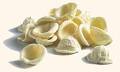
You have to start off boiling a big pot of water for the broccoli rabe. Get that going first. In the meantime, wash up the broccoli rabe and cut it into one to two inch pieces. Get the water going for the pasta too. I believe it’s supposed orecchiette, so that’s what I use, little ear-shaped pasta.
After the big pot of water is boiling, blanch the broccoli rabe for about 3-4 minutes. You can tell when it’s done because you’ll begin to smell the greens. Take them out and into a colander, shock them with some cold water to stop the cooking and preserve the green color.
Slice up some Italian or Italian-like sausage. I used D’Artagnan Mediterranean chicken sausage tonight. It wasn’t as heavy as the Aidells chicken sausage, so it made the dish lighter. Sauté the sausage slices in a skillet with a little bit of olive oil if you’re using a chicken sausage. Let them cook through.
Once the water in the other pot is boiling you’ll be ready to cook the pasta. It will take about 11 minutes for orecchiette.
Put about a tablespoon and a half of olive oil in the empty big pot that cooked the broccoli rabe. Toss in a peeled garlic clove, and turn on the heat so that the olive oil warms and is infused with the garlic. Throw in the cooked broccoli rabe, and let it sauté for a couple of minutes. I add salt, pepper, and a dash or two of hot red pepper flakes.
When the pasta is done, drain it, reserving some of the cooking liquid. Combine the pasta with the broccoli rabe, the sausage, and some freshly grate romano cheese. Serve and be thankful that you get to sit down.
Subscribe to:
Posts (Atom)